
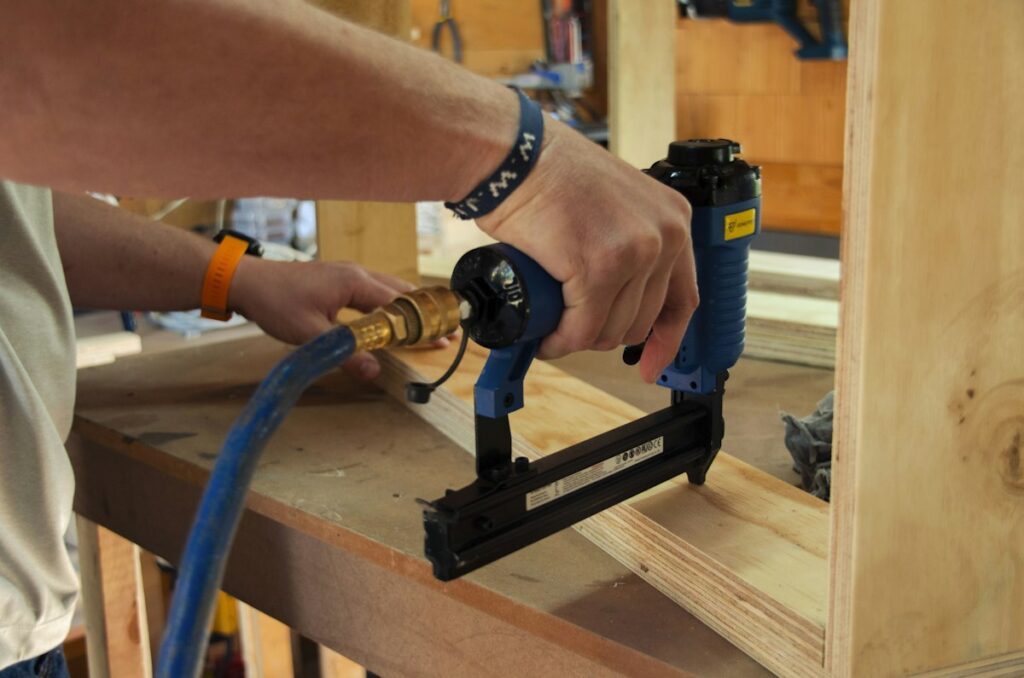
For most homeowners doing trim, molding, and furniture-grade projects, a cordless 16-gauge finish nailer on the same battery platform as your existing drill is the right choice over a pneumatic model, because it skips the compressor and hose entirely while still driving nails clean enough for paint-grade trim. The exceptions are high-volume production work, where a pneumatic nailer’s lower per-shot cost and lighter gun weight still win, and very delicate trim work, where an 18-gauge brad nailer leaves a smaller, easier-to-fill hole. Here is how to sort through the spec sheet without getting distracted by marketing claims that don’t affect the work.
Pneumatic vs. Cordless: Which Should You Buy?
Pneumatic nailers are cheaper upfront, lighter in your hand since the motor and battery live in the compressor instead of the tool, and never run out of charge mid-project, but they tie you to a hose, which is a real limitation on ladders, in attics, or moving room to room. Cordless nailers trade a bit of weight and a higher upfront cost for total mobility, and for the typical homeowner doing baseboard, door casing, or shelving a few times a year rather than daily, that mobility is worth more than the weight difference or the per-unit cost of a compressor you’d otherwise need to buy anyway.
Key Specs That Actually Matter
Gauge
Gauge refers to nail thickness: 15-gauge nails hold larger trim and crown molding securely but leave a bigger hole to fill, 16-gauge is the most versatile middle ground for baseboard, casing, and chair rail, and 18-gauge brad nails are thinner, leave nearly invisible holes, and suit delicate trim, shoe molding, and small craft or furniture work, but they hold less and can be pulled out more easily under stress.
Battery Platform
If you already own a cordless drill or impact driver, buying a nailer on the same battery platform is the single highest-value decision in this purchase, since it means one charger, shared batteries, and no redundant equipment sitting unused. Buying into a brand-new platform just for one tool rarely pays off unless you’re planning to build out that brand’s broader lineup.
Depth of Drive Adjustment
A tool-free dial that lets you adjust how deep the nail sets without a wrench or screwdriver is genuinely useful, since different trim materials (MDF versus hardwood versus softwood) need different depths, and a dial lets you adjust between cuts rather than stopping to find a tool.
Weight and Balance
Cordless nailers run 1 to 2 pounds heavier than their pneumatic counterparts because they carry a motor, gas cartridge or battery, and firing mechanism onboard. For overhead work like crown molding, that difference matters more than the spec sheet suggests, so if you can, handle the tool in person before buying rather than ordering based on weight listed online alone.
Best Uses Around the House
A 16-gauge cordless finish nailer handles the bulk of homeowner trim work: baseboard, door and window casing, chair rail, and wainscoting. An 18-gauge brad nailer is the better call for shoe molding, cabinet face frames, and small picture frame or furniture builds where hole size matters more than holding power. If you’re planning to hang heavier crown molding or install larger baseboard in an older home with thicker trim profiles, step up to 15-gauge, which holds significantly more weight.
What to Skip (Features That Don’t Matter)
Dual-mode firing (sequential versus bump/contact fire) is a genuinely useful safety feature and worth having, but beyond that, extras like app connectivity, RGB work lights, and oversized LCD displays add cost without adding function for a homeowner doing occasional trim work. Nail capacity above about 100 nails per magazine load is also a marketing point more than a practical one for most projects, since you’re reloading between rooms anyway.
Budget vs. Pro-Grade: Is It Worth Spending More?
Entry-level cordless finish nailers in the $150 to $220 range handle occasional homeowner projects fine, but they tend to have shorter battery life per charge and less consistent depth-of-drive control. Pro-grade tools in the $280 to $400 range are worth the jump if you’re outfitting a workshop, doing trim work across an entire house, or simply want a tool that will still perform reliably after several years of regular use; for a single weekend project, the budget tier is usually the better value.
Frequently Asked Questions
What gauge finish nailer should I buy for baseboard?
16-gauge is the most versatile choice for standard baseboard and door casing. Step up to 15-gauge for thicker, heavier trim profiles common in older homes.
Is a cordless finish nailer as powerful as a pneumatic one?
Modern battery-powered finish nailers from major brands drive nails just as deep and consistently as pneumatic models for typical trim work; the main tradeoffs are tool weight and upfront cost, not driving power.
Should I buy a nailer on the same battery platform as my drill?
Yes, if you already own cordless tools. Sharing a battery platform saves money over time and means you’re never stuck with a charged drill and a dead nailer, or vice versa.
What’s the difference between a finish nailer and a brad nailer?
A finish nailer (typically 15- or 16-gauge) drives thicker nails for structural trim like baseboard and casing. A brad nailer (18-gauge) drives thinner nails that leave smaller holes, suited to delicate trim and small craft or furniture projects.
Do I need a compressor if I buy a cordless nailer?
No. That’s the main appeal of cordless models: the firing mechanism is self-contained in the tool, so you don’t need a compressor, hose, or air fittings at all.
For complex structural, electrical, gas, and other safety-critical work, consult a qualified professional and check local requirements.
Read Next
All articles →
Cordless vs. Corded Impact Drivers: Which One Actually Belongs in Your Toolbox
For the vast majority of homeowners, a cordless impact driver is the better choice over a corded one, because modern brushless…
Read the guide →
PEX-A vs. PEX-B: Which to Choose for a DIY Repipe
PEX-A and PEX-B compared on flexibility, fittings, cost, and code acceptance to help you choose the right pipe for a DIY…
Read the guide →
The 12 Essential Tools Every New Homeowner Should Own Before Tackling Fall Projects
The 12 Essential Tools Every New Homeowner Should Own Before Tackling Fall Projects
Read the guide →