
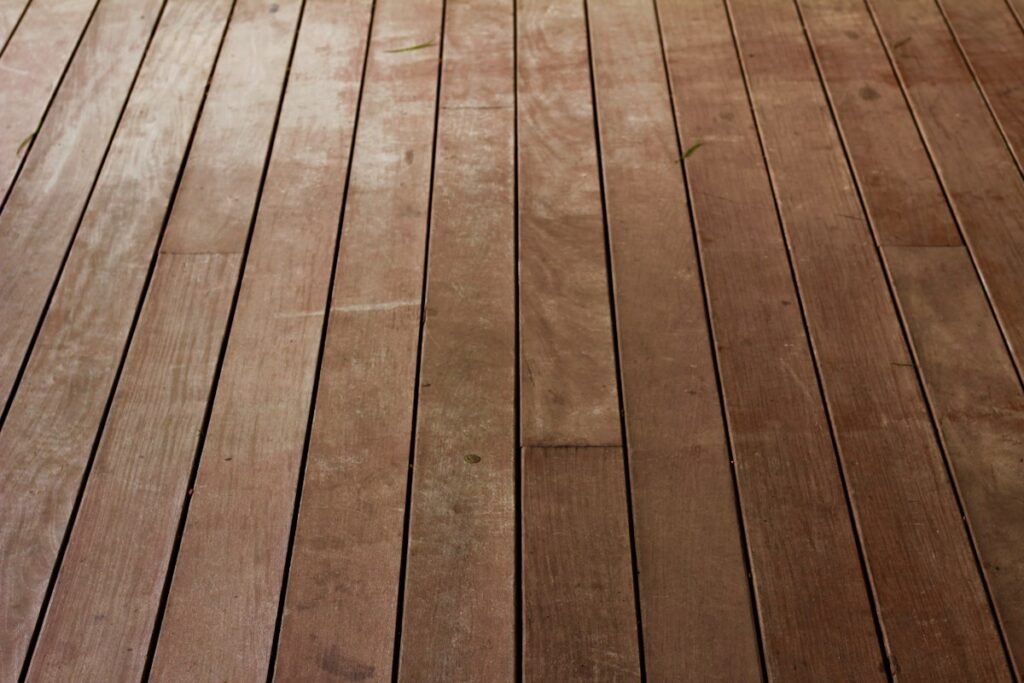
Solid hardwood is generally the better match for an old house because it can be sanded and refinished many times over a century or more, matching the longevity of original 1900s-to-1950s flooring. Engineered hardwood is the smarter pick when you’re installing over concrete, in a basement, or over radiant heat, since its plywood core resists the expansion and contraction that can crack solid boards in those conditions. The right answer depends less on which product is “better” and more on where in the house you’re installing it.
What’s Actually Different
Solid hardwood is a single piece of wood, typically 3/4-inch thick, milled from one species top to bottom. Engineered hardwood is a real hardwood veneer, usually 1/16 to 1/6-inch thick, bonded to a plywood or high-density fiberboard core. Both are “real wood” on the surface — engineered isn’t laminate or vinyl — but the difference in construction changes how each performs.
Refinishing: Solid Wins by a Wide Margin
A 3/4-inch solid oak floor can typically be sanded and refinished five to seven times over its life, roughly once every 10 to 15 years, which is why so many century-old homes still have their original floors. Engineered flooring’s thin veneer can usually only be refinished once, sometimes twice if the wear layer is on the thicker end (3mm or more). If you’re restoring a historic home and want floors that will genuinely last another 100 years, solid is the only real option.
Moisture and Stability: Engineered Wins in Problem Areas
Solid hardwood expands and contracts significantly with humidity swings, which is why it’s never recommended below grade or over concrete slabs — old farmhouses with fieldstone foundations and damp basements are a textbook case where solid wood will cup or gap. Engineered flooring’s cross-layered core resists this movement, making it the right call for basements, homes near the coast, or any room with radiant floor heat, where solid wood is prone to gapping as the subfloor heats and cools.
Cost Comparison
Solid hardwood runs $6 to $12 per square foot for material, plus $4 to $8 per square foot for installation, sanding, and finishing on-site. Engineered hardwood ranges $4 to $11 per square foot for material and is often faster and cheaper to install, since many products click together without nails or on-site finishing. For a 1,000-square-foot main floor, that can mean a difference of $2,000 to $5,000 between the two.
Historical Accuracy for a Period Home
If you’re restoring a specific era — narrow-plank quartersawn oak in a Craftsman bungalow, or wide pine boards in a Colonial — solid wood in the correct species and plank width will look and age more authentically than most engineered options, which tend to come in a narrower range of standard widths and finishes. That said, high-end engineered products with wide, hand-scraped, or wire-brushed finishes have closed much of that gap in recent years.
Where to Use Each in an Old House
Use solid hardwood on main living levels above grade where you want long-term refinishing potential and the most historically accurate look. Use engineered hardwood in basements, over concrete, in additions with radiant heat, or in any room where moisture is a recurring issue, like a converted sunporch or a kitchen with a history of leaks.
Frequently Asked Questions
Can you refinish engineered hardwood floors?
Yes, but only if the wear layer is at least 2mm thick, and usually only once or twice in the floor’s lifetime, compared to five or more times for solid hardwood.
Is engineered hardwood as durable as solid hardwood?
Day-to-day durability is similar since both have a real hardwood surface. The difference shows up over decades: engineered has a shorter total lifespan because of its thin wear layer.
Can solid hardwood be installed over a concrete slab?
It’s not recommended without a raised subfloor system, because concrete holds moisture that causes solid wood to cup and warp. Engineered flooring is the standard choice over slab.
Which is better for resale value, solid or engineered hardwood?
Solid hardwood generally carries a slight edge in buyer perception and appraisal, but high-quality engineered flooring in the right location (basements, over radiant heat) is viewed as the correct technical choice and doesn’t hurt value.
How do I tell if existing old-house floors are solid or engineered?
Check a floor vent, closet, or transition strip where the edge is visible. Solid boards show consistent wood grain all the way through the edge; engineered boards show a visible plywood or fiberboard layer beneath a thin veneer.
For complex structural, electrical, gas, and other safety-critical work, consult a qualified professional and check local requirements.
Read Next
All articles →
Basement Bathroom Addition: What a Below-Grade Bathroom Really Costs and Requires
A basement bathroom addition typically costs between $8,000 and $25,000 depending on plumbing complexity, and the single biggest factor is whether…
Read the guide →
Budgeting a Mid-Range Kitchen Remodel: What Your Money Actually Buys
Focus keyword: mid-range kitchen remodel cost The single biggest source of frustration in kitchen renovations isn’t the mess or the timeline…
Read the guide →
Small Bathroom Remodel: Where to Splurge and Where to Save
Focus keyword: small bathroom remodel budget
Read the guide →