
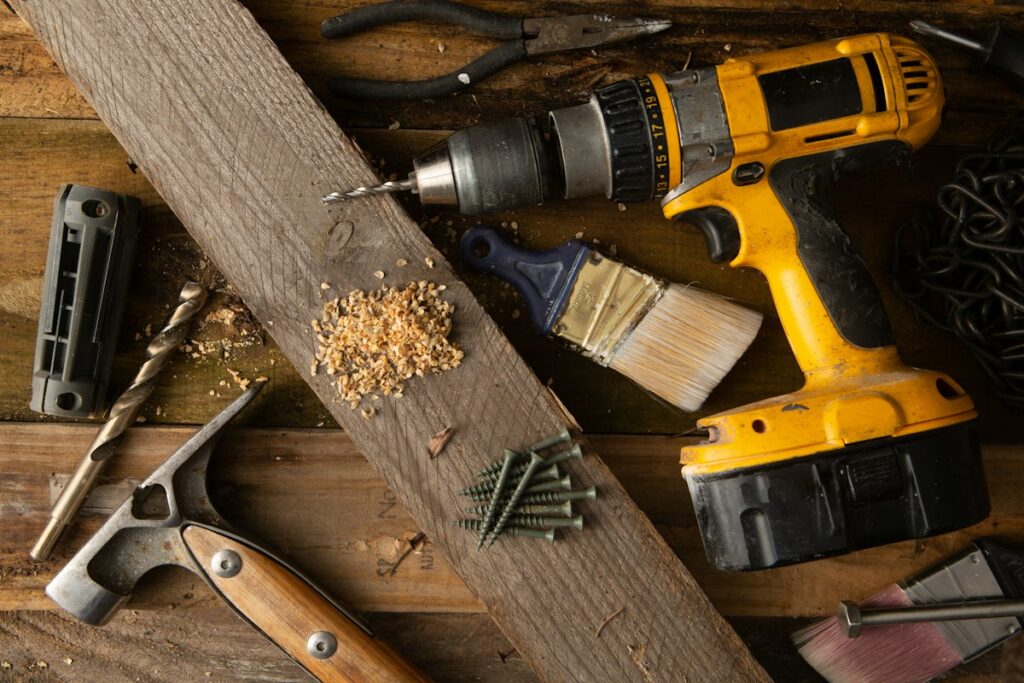
If you just bought your first home, it’s tempting to buy tools reactively — running to the hardware store every time something new comes up. A better approach is building a small, solid core toolkit up front. You don’t need a garage full of specialty equipment; a well-chosen set of fifteen tools will cover the vast majority of everyday repairs, hangings, and small projects. Here’s what belongs in that starter kit, and why.
1. A Claw Hammer
The most basic tool in any kit, useful for driving nails, light demolition, and pulling nails with the claw end. A 16-ounce curved-claw hammer is a comfortable, versatile choice for most household tasks.
2. A Multi-Bit Screwdriver Set
Look for a set that includes both Phillips and flathead heads in multiple sizes, ideally with a magnetic tip and interchangeable bits. This single tool will handle most furniture assembly, cabinet hardware, and small appliance repairs.
3. An Adjustable Wrench
Rather than buying a full set of fixed wrenches right away, one or two adjustable wrenches in different sizes handle plumbing nuts, bolts, and hardware of varying sizes without needing an exact match.
4. A Tape Measure
A 25-foot tape measure is long enough for most household measuring — furniture placement, room dimensions, and project planning — while still being compact enough to keep in a drawer or on your belt.
5. A Level
Whether you’re hanging a picture, mounting a shelf, or installing curtain rods, a level ensures things actually look right once you step back. A 24-inch level covers most household needs; a smaller torpedo level is handy for tighter spaces.
6. A Stud Finder
Anything you’re mounting that needs to hold real weight — shelves, TVs, heavy mirrors — should be anchored into a wall stud whenever possible. An electronic stud finder takes the guesswork out of locating them.
7. A Utility Knife
Useful for opening boxes, cutting drywall, trimming caulk lines, and dozens of other small cutting tasks. Choose one with a retractable blade and replaceable blade cartridges.
8. A Set of Pliers
A basic set — slip-joint pliers for gripping, needle-nose pliers for tight spaces, and locking pliers for holding things firmly in place — covers most everyday gripping and pulling tasks.
9. A Cordless Drill/Driver
Arguably the single most-used power tool in a homeowner’s kit, a cordless drill handles everything from assembling furniture to hanging shelves to driving deck screws. Look for one that comes with at least two batteries so you’re never stuck mid-project waiting on a charge.
10. A Hand Saw
A basic hand saw handles occasional cuts on wood trim, branches, or lumber without the cost, storage space, or learning curve of a power saw. It’s a low-risk tool to have on hand for occasional use.
11. A Sturdy Stepladder
Choose a ladder rated for your weight plus whatever you’ll be carrying, with a duty rating printed on the label — don’t guess. A 4- to 6-foot fiberglass or aluminum stepladder covers most indoor tasks like changing light bulbs, cleaning, and reaching upper cabinets. Always keep three points of contact, never stand on the top rung or the paint shelf, and set it on a flat, stable surface.
12. A Flashlight or Headlamp
For checking crawl spaces, attics, breaker panels, or working during a power outage, a reliable flashlight or hands-free headlamp is essential. Keep spare batteries with it.
13. Basic Safety Gear
Safety glasses, work gloves, and a dust mask cost very little and prevent real injuries. Keep them near your main toolkit so there’s no excuse to skip them for a “quick” job.
14. A Caulk Gun
Useful well beyond bathroom caulking — sealing exterior gaps, weatherproofing, and general home maintenance all rely on this simple, inexpensive tool.
15. A Non-Contact Voltage Tester
Before touching any wiring — even for something as simple as replacing a light fixture or outlet cover — a non-contact voltage tester lets you confirm a circuit is actually dead after you’ve switched off the breaker. It’s a five-dollar tool that adds a critical layer of safety to any electrical task. It does not replace turning off the breaker first, and for anything beyond simple fixture or outlet swaps, hire a licensed electrician.
Quick Reference Checklist
– Claw hammer
– Multi-bit screwdriver set
– Adjustable wrench(es)
– 25-foot tape measure
– Level (24-inch plus a torpedo level)
– Electronic stud finder
– Utility knife with retractable blade
– Pliers set (slip-joint, needle-nose, locking)
– Cordless drill/driver with two batteries
– Hand saw
– Rated stepladder
– Flashlight or headlamp with spare batteries
– Safety glasses, gloves, and a dust mask
– Caulk gun
– Non-contact voltage tester
Store everything in a toolbox or a small wall-mounted pegboard so it’s easy to find when you need it — the fastest way to lose enthusiasm for a project is spending twenty minutes hunting for a screwdriver. Build this kit once, and you’ll be ready for the vast majority of what comes up in year one of homeownership and well beyond.
For complex structural, electrical, gas, and other safety-critical work, consult a qualified professional and check local requirements.
Read Next
All articles →
Cordless Drill vs. Impact Driver: Which One Do You Actually Need First?
Cordless drill or impact driver for your first tool? Compare torque, use cases, battery systems, and which one to buy first…
Read the guide →