
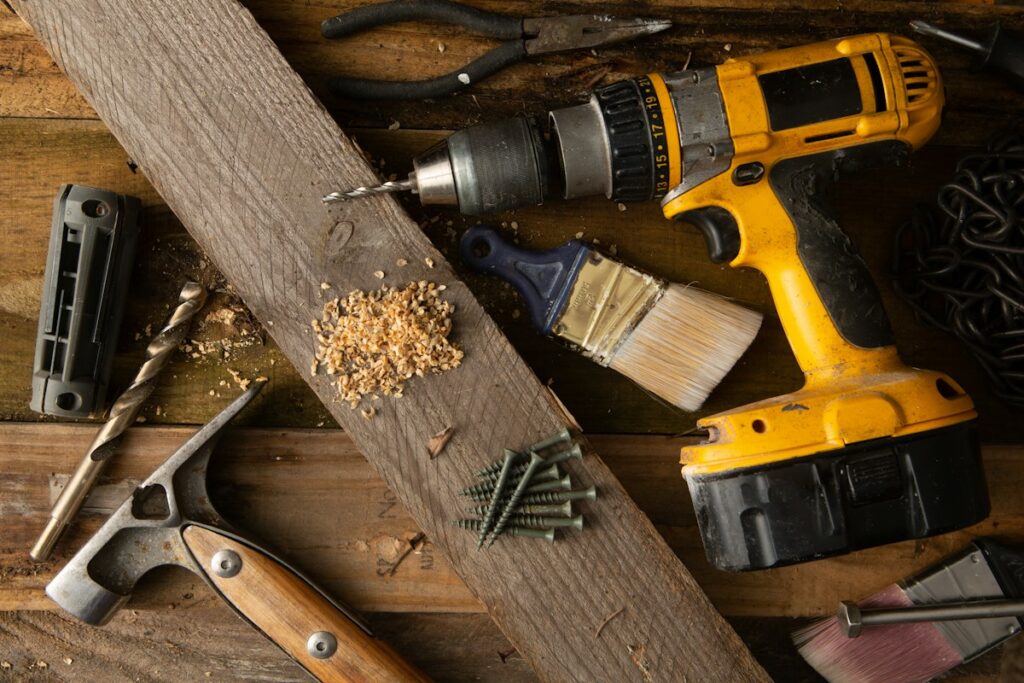
If you can only buy one tool first, buy the cordless drill, not the impact driver. A drill handles drilling holes, driving small to medium screws, mixing paint, and using dozens of attachment accessories, while an impact driver is a specialist tool built almost entirely for driving long or large-diameter fasteners quickly. Most homeowners reach for a drill far more often than an impact driver in typical repair and DIY work.
What Each Tool Is Actually Built For
A cordless drill uses a keyless or keyed chuck that grips round-shank bits, letting it drive screws, bore holes with twist bits, use hole saws, and run accessories like wire brushes, paint mixers, and sanding pads. It applies rotational force smoothly and lets you control speed and torque with precision, which matters when you’re driving into drywall or finishing delicate work.
An impact driver uses a quick-release hex chuck built for driving bits, and it delivers rotational force in rapid, high-torque bursts rather than smooth continuous rotation. That impacting action is what lets a relatively compact, lightweight tool drive 3-inch deck screws or lag bolts without stalling or stripping the fastener head, something a standard drill struggles with once fasteners get long or the material gets dense.
Where a Drill Wins
Drilling precise holes (for hinges, shelf pins, dowels, or pilot holes), driving small screws into drywall or trim where a drill’s adjustable clutch prevents overdriving, and running rotary accessories are all drill-first jobs. If your typical project list includes hanging shelves, assembling furniture, installing cabinet hardware, or general household repairs, a drill covers nearly everything.
Where an Impact Driver Wins
Building a deck, framing, installing large lag bolts, driving screws into hardwood or engineered lumber, and any job involving long fasteners in dense material are where an impact driver earns its keep. It’s also noticeably better at removing rusted or stripped screws because the impacting action breaks them loose without camming out the bit.
Battery Systems Matter More Than the Tool Itself
Before buying either tool, pick a battery platform (the same brand’s ecosystem of batteries and chargers) you plan to stick with, because batteries and chargers are usually the most expensive part of a cordless tool purchase. Buying a “bare tool” (drill or driver only, no battery) within a platform you already own saves significantly over buying a new kit with its own charger and batteries every time.
Can One Tool Do Both Jobs?
A hybrid “drill driver” with a hex quick-release chuck exists, and some combo kits bundle a drill and an impact driver together at a lower combined price than buying each separately. For most home DIYers, a basic 12V or 18V drill driver kit, bought first, handles 80 to 90 percent of projects, with an impact driver added later once deck, fence, or framing projects come up.
Noise, Size, and Everyday Usability
Impact drivers are noticeably louder than drills, especially when under load driving long fasteners, which matters if you’re working in a shared wall apartment or doing projects early in the morning or evening. Impact drivers also tend to be shorter front-to-back than a comparable drill, which can be an advantage in tight cabinet interiors or between wall studs, even though both tools are compact compared to their corded ancestors. If you’re drilling overhead for any length of time, such as installing ceiling-mounted shelving or light fixtures, the lighter weight of a compact drill is usually easier on the arms than a bulkier impact driver, though this varies by specific model and battery size.
What a Starter Toolkit Should Actually Include
Beyond the drill or driver itself, a well-rounded starter kit includes a set of quality driving bits in a range of sizes, a set of twist drill bits for wood and metal, a stud finder, a basic level, and a tape measure. Many manufacturers sell combo kits bundling a drill and impact driver together with two batteries and a charger, which is often the better value than buying either tool alone, especially for anyone who already suspects they’ll want both tools within the first year or two of home ownership or serious DIY work.
Frequently Asked Questions
Can an impact driver replace a drill entirely?
Not well. Impact drivers struggle with precise, controlled drilling and don’t accept standard round-shank drill bits or most rotary accessories, so they’re a poor substitute for a drill’s versatility.
Is an impact driver more powerful than a drill?
In terms of torque for driving fasteners, yes. But “more powerful” doesn’t mean more useful for every task; a drill’s controlled torque is better suited to delicate or precise work.
Do beginners need an impact driver at all?
Not immediately. Most beginner project lists (shelving, furniture assembly, small repairs) are drill-first tasks. An impact driver becomes worth owning once outdoor building projects or framing work come up.
What battery voltage should a first-time buyer choose?
18V (or 20V Max, depending on brand labeling) kits offer the best balance of power and battery life for most home projects, while 12V kits are lighter and fine for smaller, lighter-duty work.
Are brushless motors worth the extra cost?
Generally yes for anyone using the tool regularly; brushless motors run cooler, last longer, and extend battery runtime compared to brushed motors, though occasional-use buyers may not notice much difference.
For complex structural, electrical, gas, and other safety-critical work, consult a qualified professional and check local requirements.
Read Next
All articles →
The 15 Essential Tools Every First-Time Homeowner Should Own
The 15 Essential Tools Every First-Time Homeowner Should Own If you just bought your first home, it's tempting to buy tools…
Read the guide →